
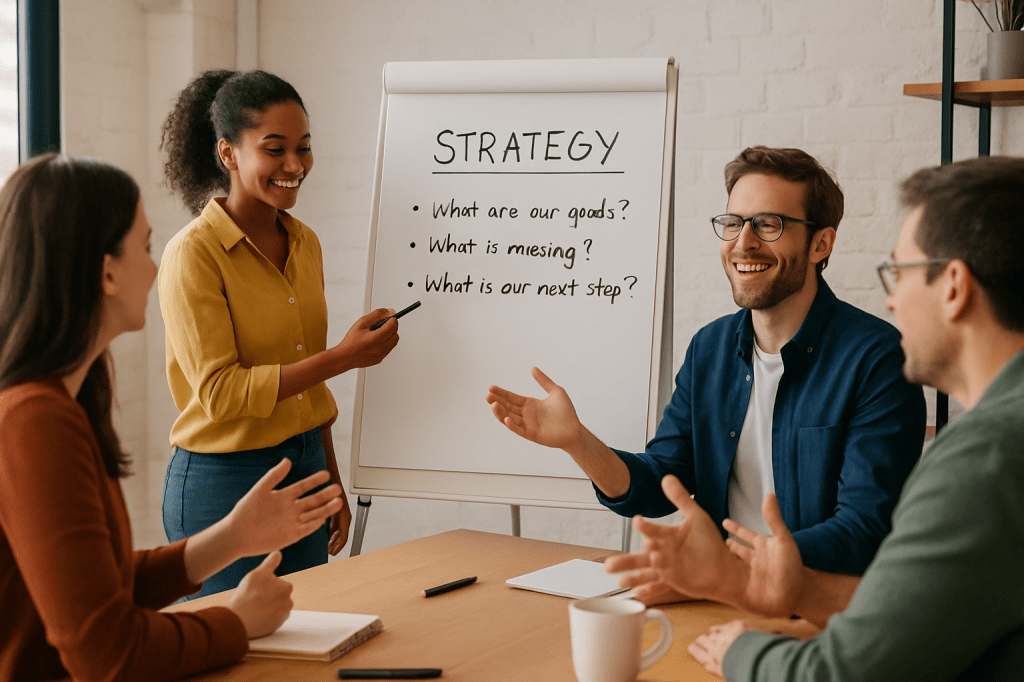
Whether it is in business, personal development, financial planning or improving wellbeing, setting a meaningful strategy is more than creating a to-do list or refining what you’re already doing. It’s about choosing, with intention, where to focus your energy—and being courageous enough to ask: What’s missing? What matters most? What will truly move the needle?
Strategy Is Not a Plan
Richard Rumelt, in his seminal book Good Strategy/Bad Strategy, makes a clear distinction: strategy is not goal-setting, and it’s certainly not a task list. Strategy is a coherent response to a challenge. It aligns resources with outcomes. In other words, it’s not about doing more things—it’s about doing the right things for the right reasons.
Too often, we confuse busy-ness with progress. We default to routines, repeat the same planning cycles, or double-down on what’s already in motion. But without stepping back to ask why we’re doing something and what success looks like, we can end up with beautifully executed plans that take us nowhere meaningful.
What Does Success Look Like?
This is the question that sits at the heart of good strategy, irrespective of the subject matter. Whether you’re building a house or planning your career, clarity about what success means is everything. Is it feeling more present in your daily life? Is it attracting five new coaching clients? Is it being able to switch off your laptop before 6pm each evening? Is it engaging and changing behaviour with a target audience so that they xyz (insert desired impact or action)?
Good strategy defines success in context. It doesn’t just set arbitrary targets—it links those targets to what you care about and what you’re uniquely positioned to do.
Aligning Actions with Purpose
Once you know what success looks like, the next critical step is alignment. This is where strategy really earns its keep. Are your daily and weekly activities truly aligned with your overall goals? Or are they things you’ve always done, things others expect you to do, or things that are “nice to have” but not essential?
Intentional strategy means asking yourself:
How does this activity move me toward my goal? What outcomes do I expect from this? If I stopped doing this, would it really matter?
What’s Missing?
One of the most powerful strategy questions is: What haven’t we done before that we could? Often the greatest opportunities lie not in what we’re repeating, but in what we’ve overlooked or avoided.
Diagnosing the underlying problem or barrier before acting often involves seeing what isn’t there, not just what is.
What If There Were No Risks?
This is one of my favourite questions, and can often create some surprising insights. This reframes your thinking and surfaces the ideas you’re most drawn to but hesitant to pursue. Sometimes, we get stuck because we can only see the risks—not the potential.
You might discover that what you really want to do is start that podcast, quit a draining project, or take a sabbatical to write your book. From there, strategy becomes about managing the risks and identifying what needs to be true or in place to make that happen, not denying your ambition.
What Needs to Be in Place?
An honest strategy also asks: What do I need that I don’t have yet? This could be time, skills, money, support, or confidence. Ignoring these gaps doesn’t make them go away—it just makes success harder.
What Do I Want to Keep?
Not everything needs to change. Part of good strategy is preserving the things that are working. What gives you energy? What generates results? What aligns with your values? Keep those things—and protect them fiercely.
Why Strategy Is Tough
Setting an intentional strategy is hard. It demands clarity, honesty, and courage. It sometimes means saying no to good ideas to focus on the best ones. It means making decisions with imperfect information and sometimes taking the first step without knowing exactly where it will lead.
But the reward? Progress that feels purposeful.
Over to You
Take a moment this week to reflect on your own goals—whether personal or professional—and ask:
What does success really look like?
Where am I repeating instead of rethinking?
What would I do if I wasn’t afraid?
Great strategy and meaningful outcomes begin with great questions after all.
Discover more from LivingInAlignment
Subscribe to get the latest posts sent to your email.
 LivingInAlignment
2 replies on “Crafting Intentional Strategies for Meaningful Success”
Yeah, iintention is the key bit. Shame it can be so elusive sometimes!
Nice blogpost,
M
True, and why laying the groundwork to understand your values or longer term aim is so important. If everything is a priority, then nothing is a priority 😉