
When we think about strategic planning, it’s easy to picture boardrooms, spreadsheets, and long-term forecasts. But at its heart, strategy is about people – their aspirations, their shared purpose, and the steps they take together to create meaningful outcomes. The tools we choose can either feel rigid and transactional or become catalysts for connection and creativity.
In this post, we’ll explore two powerful frameworks – SOAR and OKRs – and how they can help you not only reflect personally but also bring teams together to co-create a vision and actionable next steps.
Why SOAR Instead of SWOT?
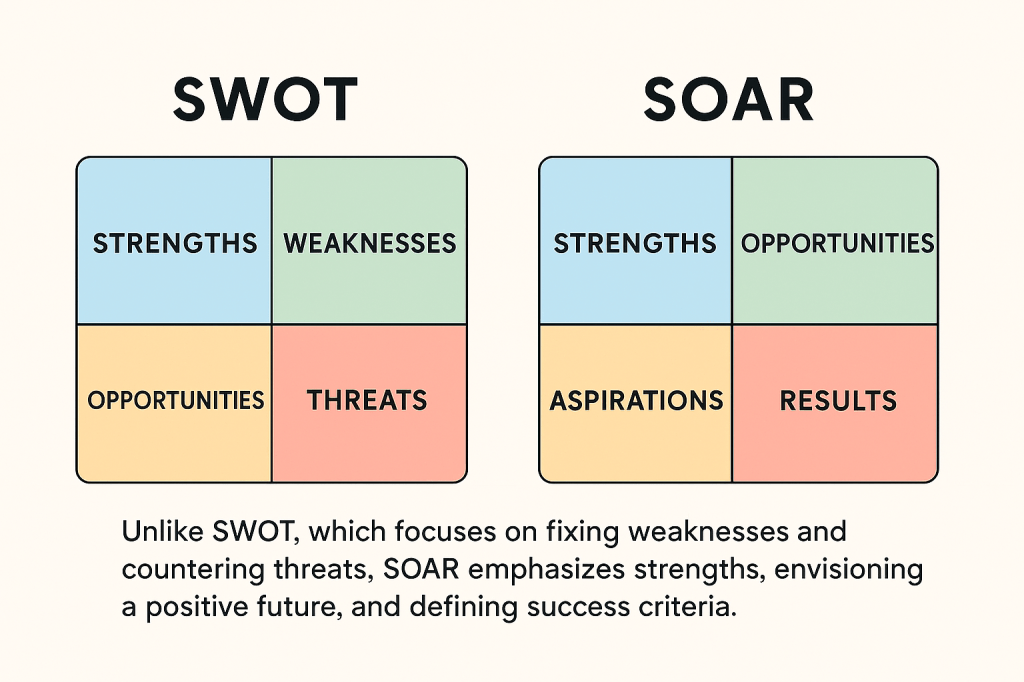
Many of us are familiar with SWOT (Strengths, Weaknesses, Opportunities, Threats). While useful, it often leans towards problem-solving and risk mitigation. SOAR – which stands for Strengths, Opportunities, Aspirations, and Results – takes a more generative approach. It invites us to focus on what’s working well and what’s possible, rather than what’s broken.
- Strengths: What are we great at? What energises us?
- Opportunities: Where can we grow? What trends or possibilities excite us?
- Aspirations: What do we truly want to become? What future feels inspiring?
- Results: How will we know we’ve succeeded? What outcomes matter most?
SOAR is not just a planning tool; it’s a conversation starter. It encourages dialogue that feels positive and future-focused, helping individuals and teams align around shared aspirations.
(For more on SOAR, see https://www.centerforappreciativeinquiry.net/strategic-planning/soar/.)
OKRs: Turning Vision into Action
Once you’ve articulated aspirations, you need a way to translate them into tangible steps. That’s where OKRs – Objectives and Key Results – come in. Popularised by organisations like Google, OKRs help teams set ambitious goals and measure progress with clarity.
- Objectives: What do we want to achieve? These should be inspiring and directional.
- Key Results: How will we measure success? These should be specific, time-bound, and verifiable.
OKRs work beautifully alongside SOAR because they take big-picture aspirations and anchor them in measurable outcomes. They also foster transparency and alignment, making it easier for everyone to see how their work contributes to the bigger picture.
(For more on OKRs, visit https://www.whatmatters.com/.)
Other Tools to Consider
If you’re looking to expand your toolkit, here are a few more approaches that complement SOAR and OKRs:
- Visioning Workshops: Guided sessions that help teams imagine their ideal future state.
- Appreciative Inquiry: A strengths-based methodology for organisational change.
- Hoshin Kanri: A Japanese approach to aligning strategic goals with daily activities.
- Impact Mapping: A visual way to connect deliverables to desired outcomes.
Each of these tools shares a common thread: they encourage dialogue, clarity, and shared ownership.
Bringing It All Together
Strategic planning doesn’t have to feel like a top-down exercise. When we use tools like SOAR and OKRs thoughtfully, they become vehicles for connection – helping individuals reflect on their own goals while co-creating a collective vision. The result? A sense of alignment that feels energising and purposeful.
References & Further Reading
Discover more from LivingInAlignment
Subscribe to get the latest posts sent to your email.
 LivingInAlignment